
Automation and the use of AI for wrinkle detection and robotic seat steaming in automotive seat production become challenging when different seat models with covers made of textile, vinyl, or leather are processed on the same production line.
The methods used to remove wrinkles and the optimal control parameters for the steaming robot vary depending on the material – and this is exactly where the challenges for quality and efficiency begin.
Quality managers often report high levels of rework and rising process costs, as well as strong dependence on experienced operators when optimizing the steaming process using AI. In many plants, robots are already installed, but they typically steam the entire seat surface regardless of whether wrinkles are present. This leads to unnecessary energy consumption, increased material wear, and inefficient processes. With a fixed cycle time of 53 seconds, there is also little room for manual corrections.
AI-based optimization of the seat steaming process in series production
The SCIIL VISION (VisuSteam) system combines camera-based AI wrinkle detection with direct integration into robot and production line control systems. It automatically identifies the seat model as well as the cover material – leather, vinyl, or textile – and selects the appropriate process parameters.
The result is a self-learning closed-loop mechanism that automatically adjusts control parameters and continuously improves the process from cycle to cycle.
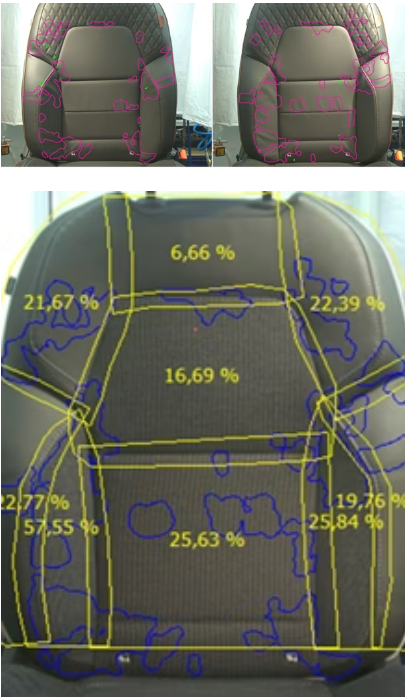
Line control provides seat data: unique serial number, model, variant, and cover material
Cameras capture images under the proper lighting conditions

AI detects and classifies wrinkles by position, direction, and severity
The system assigns ironing zones and parameters (zone priority, pressure, cycles, etc.)
The robot steams targeted zones according to zone-specific instructions
AI verifies the result again after steaming
Parameters are automatically adjusted when required (self-learning control loop)
Production and quality managers receive a solution that not only automates the process but also continuously optimizes it – ideal for production lines with high cycle rates and consistent quality requirements.
Implementation and Boundary Conditions
The customer produces seats with covers made of textile, vinyl, or leather in numerous model variants with different shapes, designs, and seam layouts. The production line operates with a fixed cycle time of 53 seconds, of which only 48 seconds are effectively available for the steaming process.
The central challenge is to reliably detect wrinkles, automatically apply optimal steaming parameters depending on material and zone, and continuously optimize the entire process through AI-based wrinkle detection and robotic steaming control.
Verification Test After Project Completion
Results of a one-hour test run with 63 seats:
- ~99% of wrinkles are correctly detected
- <6% false detections (false positives)
- Only 0.28 – 1.58 % of the surfaces were ironed without creases


In addition to these key figures, the plant benefits from reduced manual intervention, less rework, and improved material protection – especially for sensitive cover materials such as leather.
Conclusion
The system reduces the workload for production and quality teams, standardizes results, and makes processes scalable. For production lines with high throughput and clearly defined cycle times, this represents a significant competitive advantage.
- Lower Cost of Poor Quality (CoPQ)
- Minimized unnecessary steaming
- Complete traceability
- Standardized and reproducible quality
- Simple rollout to additional production lines