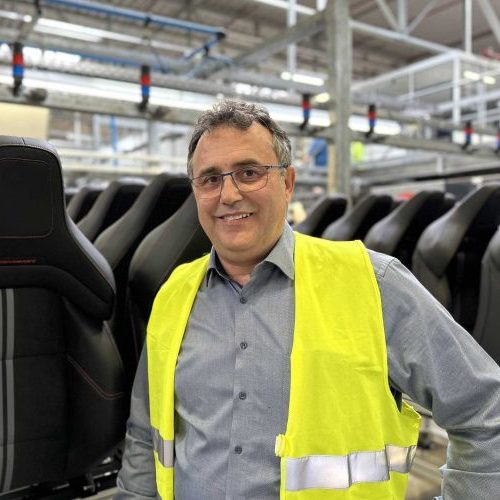
Research and development in industrial software is a central component of the innovation strategy of SCIIL AG and UAB Sciil Baltic. We are continuously developing digital solutions for production, quality assurance and AI-supported data analysis as part of national and European funding programs for innovation and research as well as self-financed projects. On this page, we present our ongoing and completed research and development projects transparently and in accordance with the requirements of the respective funding institutions.

AI-Based Smart Steaming for Automotive Seat Manufacturing
Development of an AI-Based Smart Steaming Solution for Autonomous Optimization of Industrial Processes in Automotive Seat Manufacturing
The objective of the project is a new AI-based Smart Steaming solution that extends industrial AI visual inspection beyond defect detection toward autonomous process optimization.
The project combines computer vision, deep learning, and industrial process data to train a proprietary AI model capable of learning the optimal steaming strategy for each seat variant and material. Using visual inspection before and after the steaming process, the AI continuously improves steaming parameters such as robot trajectories, pressure, timing and zone priorities, significantly reducing ramp-up time while improving product quality and process stability.
The project builds on SCIIL’s proven AI VISION platform for automated visual quality inspection and represents the next step from AI-based defect detection to AI-driven process optimization for automotive manufacturing.
No. 02-124-K-0085
Project promoter – Sciil Baltic, UAB
Project start date: 2 March 2026
Project end date: 14 July 2027
Project value is EUR 172.500, of which EUR 138.000 from EU support.
The project is co-financed by the European Union.
SCIIL BALTIC UAB implements the “REPORTIO II” project, an AI-based solution for poultry farms
SCIIL Baltic UAB is implementing the Reportio II project to add new, user-relevant solutions to the smart farm monitoring system based on IoT sensors, learning systems and analysis algorithms.
After the successful implementation of the project, the company’s existing product, Reportio, will be complemented with new smart solutions.
- Project title: “REPORTIO II”
- Project executing agency: UAB “Sciil Baltic”
- Project objective: The aim of the project is to add new solutions to the REPORTIO product that are relevant to users.
Project Start Date: 2024-01
Project End Date: 2026-12
Total project volume: EUR 1,638,052.06
Support from the European Regional Development Fund: EUR 737,123.44

VISION - AI-supported visual quality inspection in industrial production
Project sponsor: SCIIL AG, Germany
Funding program: Tax research allowance in accordance with the Research Allowance Act (FZulG), Federal Republic of Germany
Project objective: Development of an AI-based, OEM-agnostic platform for automated visual quality inspection in industrial production environments.
The system is designed to detect dynamic and static defects in real time and provide digital support for quality processes directly on the store floor.
Project description: As part of Innovation & Research, SCIIL is developing a modular AI visual inspection solution that integrates industrial camera systems, edge processing, server architecture and a central data and application platform.
The core of the research activities is the development of innovative deep learning models for the detection of complex, variable defect images - for example wrinkles, material deformations, soiling or assembly deviations. Both dynamic defect patterns (e.g. position-dependent defects) and static characteristics are analyzed.The technological challenge lies in particular in:the development of robust training methods for widely varying production conditions,the real-time processing of large amounts of image data,scalability to different camera types and OEM environments,and integration into existing production, MES and quality management systems.
The project is developing prototypes, implementing pilot installations and continuously optimizing algorithms. The aim is to develop a market-ready, industrially deployable solution that can be operated both on-premise and in hybrid architecture.