SCIIL VI EOL – End-of-Line Visual Inspection Software

100% Visual Inspections at EOL Stations and Quality Gates

SCIIL VI EOL is visual inspection software, which digitizes visual inspection at end-of-line stations and quality gates. Instead of relying on paper-based defect lists, manufacturers perform structured visual inspections directly within the production process. As a result, inspectors identify and document visible defects immediately and without interrupting the production flow.

Inspectors mark defects directly on the product image. Consequently, defect locations, affected components, and defect types are captured clearly and consistently. At the same time, the system stores all inspection results together with the corresponding serial number, ensuring complete traceability.

Barcode, DMC, or RFID scanners – as well as interfaces to the production line – automatically identify the serial number, product variant, and configuration. Therefore, the correct inspection checklist appears instantly, while the visual inspection is performed within the normal line cycle time without delays.
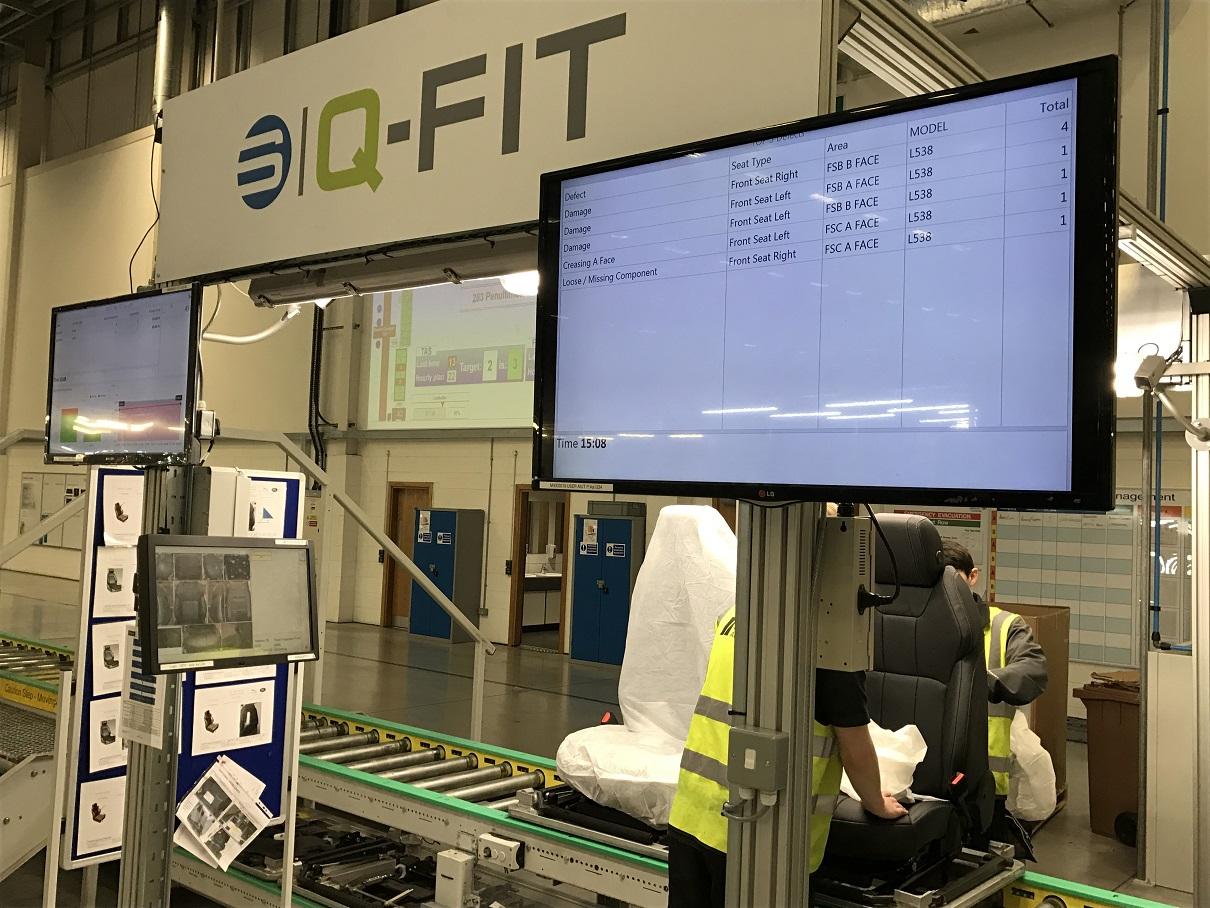
Q-Gate Seat Production

Digital Visual Inspection at the End-of-Line: Modern and Efficient

The SCIIL VI EOL visual inspection software is easy to use and designed specifically for production environments. Inspectors mark defects directly on the product image. As a result, data entry is fast, clear, and requires no additional documentation.

At the same time, the system integrates directly into the production line through interfaces with manufacturing systems as well as JIT and JIS processes. Therefore, the serial number, product variant, and configuration are automatically available.

Inspectors document the defect cause, source, and severity directly during the visual inspection. Alternatively, this information can be added later at the rework station or during downstream analysis.

As a result, the system creates a central and consistent data base. It makes defect patterns transparent and provides reliable results for end-of-line inspections and quality analysis.

Main Functions of SCIIL VI EOL

  • Graphical defect marking directly on product images
  • Automatic serial-number recognition (barcode, DMC, RFID)
  • Dynamic inspection checklists per product variant or configuration
  • Heatmap visualization of defect clusters
  • Real-time KPI dashboards for quality gates
  • Automatic quality alerts when defined limits are exceeded
  • Seamless integration with PPS or line control systems
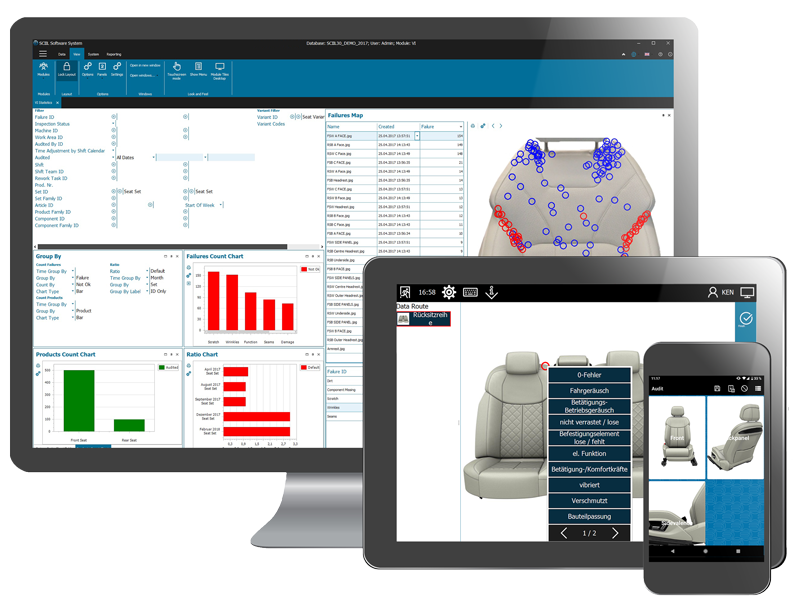
VI Graphic Input

Quality Gate Software with REWORK and TRACE

SCIIL REWORK

After the inspection, the interface to the production line automatically routes serial numbers with detected defects into the rework loop and directs them to the rework station. There, all defects associated with the serial number are clearly displayed.

During the rework process, operators record the rework type and the time required. Based on the recorded duration, the system automatically calculates the resulting rework costs.

If a specific defect occurs more frequently than the defined threshold within a certain time period, or if the calculated rework costs exceed predefined limits, the system immediately notifies the responsible managers. At the same time, a Quality Alert is displayed at the assembly station where the defect originated.

SCIIL TRACE

Thanks to serial-number-based traceability, inspection results remain fully transparent and easy to analyze:

Vertical traceability: All inspection and rework data related to a single serial number.

Horizontal traceability: Overview of all inspected products filtered by defects, inspection results, or other quality criteria.

SCIIL VI EOL inspection software makes visual end-of-line inspections more efficient, transparent, and reliable. Digital defect collection replaces paper-based defect cards, reduces rework costs, saves valuable time, and ensures consistent product quality.

As one BMW auditor summarized:

“This is the best-of-class traceability software I have experienced among our suppliers.”

If you have further questions about visual inspection, end-of-line quality control, or traceability, please visit our FAQ section.


    [acceptance wpml_attr_0='dsgvo' ] I agree

    [/acceptance]

    I agree that my details from the contact form will be collected and processed to answer my request. The data will be stored for 10 years or deleted on request. Note: You can revoke your consent at any time for the future by sending an e-mail to datenschutz@sciil.com. Detailed information on the handling of user data can be found in our privacy policy.

    With the SCIIL solution, we were able to standardize our test procedures, digitally map process steps and ensure complete traceability. Instead of many isolated solutions, we now have a common system that enables us to have more efficient processes, better data quality and faster reactions to deviations..”

    Joachim Maurer,
    Tenneco Director Quality Powertrain

    TENNECO customer reference on MES, traceability, CAQ and production data collection

    We finally wanted ONE solution for ALL production steps. The optimized processes in the final inspection bring about 15 percent efficiency gains.”

    Ulrich Albicker,
    Department Manager Quality Improvement

    Kundenreferenz von IWC zu Endkontrolle und Traceability in der Uhrenindustrie

    IWC relies on SCIIL Q-TRACE in final assembly to track watches consistently by serial number, document visual and functional tests and efficiently control rework. The result: greater transparency, measurable quality improvement and efficiency gains in final inspection, as well as seamless traceability.

    Leadec Management Central Europe

    “The intelligent tracking solution is web-based and creates cross-process transparency regarding the use and whereabouts of individual packages.

    Gerd Brandl,
    Key Account Manager Technical Solutions

    In the semiconductor industry, where sensitive precision components involve high material costs and production is subject to significant time pressure, controlling and tracing material flows is more important than ever. The smart SCOTT logistics solution, developed jointly by Leadec and SCIIL AG, provides the required transparency and control.

    “The SCIIL eLPA system is easy to use and impresses with its functionality. What is particularly important for me as a plant manager is that I have online access and a complete overview of our audits at all times – whether I’m in the office or on the road.

    Jürgen Müller,
    Plant Manager Adient Saarlouis

    Adient Saarlouis was the first plant in the Group to successfully pilot SCIIL eLPA. In the complex seat assembly process with numerous customer requirements, daily LPAs and high OEM pressure, the tool ensures a clear structure, simple implementation and maximum transparency – a must when quality has to be assured on a daily basis. Today, SCIIL eLPA is standard and runs in all Adient plants worldwide.

    “If only we had introduced SCIIL eLPA earlier – today it almost runs itself with process audits and is really well received by the team.

    Daniel Zimmermann,
    Global Commodity Buyer

    As a global automotive supplier with over 100 locations and the highest quality requirements, MAHLE needs a system that maps daily LPAs efficiently, transparently and uniformly worldwide. Manual planning and evaluation was error-prone and time-consuming – with SCIIL eLPA, a centralized system was introduced that automates planning, makes deviations immediately visible and structures the processes across all locations. This not only increases audit quality, but also ensures the necessary acceptance among users.

    “With SCIIL CAQ & TRACE, we have created uniform standards worldwide – and can react much faster. This brings more quality, more transparency and fits in perfectly with our sustainability approach.

    Johann Trischbergerr,
    COO Olymp Bezner

    Kundenreferenz von OLYMP zur MES-gestützten Produktionssteuerung in der Textilindustrie

    OLYMP uses SCIIL CAQ & TRACE to control complex inspection processes in shirt production – from incoming goods inspection to end-of-line inspection. Special inspection methods and individually defined sampling logics are also used, which have been precisely adapted to the requirements of textile production. Bidirectional integration with the ERP system ensures consistent data flows. Data is recorded directly on the line – mobile, convenient and intuitive. A strong example of successful CAQ integration in the fashion industry.