A centrally deployed LPA app enabled standardized audit requirements, comparable results, and faster knowledge sharing across 250 manufacturing and assembly plants in 33 countries worldwide.
Global Audit Standards and Faster Knowledge Sharing
In many manufacturing companies, Layered Process Audits (LPAs) were traditionally associated with significant administrative effort. Paper forms, Excel spreadsheets, inconsistent audit standards across plants, and delayed responses to quality issues often meant that audits were completed, but their full operational value remained limited.
The introduction of modern LPA apps fundamentally changed this approach.
By replacing manual processes with a centrally deployed digital solution, companies were able to standardize audit requirements across multiple sites while improving transparency and collaboration between teams.
An international automotive implementation demonstrated early how an LPA app can support global manufacturing organizations through standardized audit processes, faster knowledge sharing, and improved visibility across production sites.
Challenges of Paper-Based Layered Process Audits in Global Manufacturing
Global manufacturing organizations often face recurring challenges when audit processes are managed manually across multiple sites:
- Paper-based audit processes and spreadsheets
- Limited visibility across manufacturing sites
- Delayed escalation of audit findings
- High administrative effort for planning and documentation
- Inconsistent audit quality across locations
- Limited real-time visibility into quality issues
- Reduced traceability of actions and corrective measures
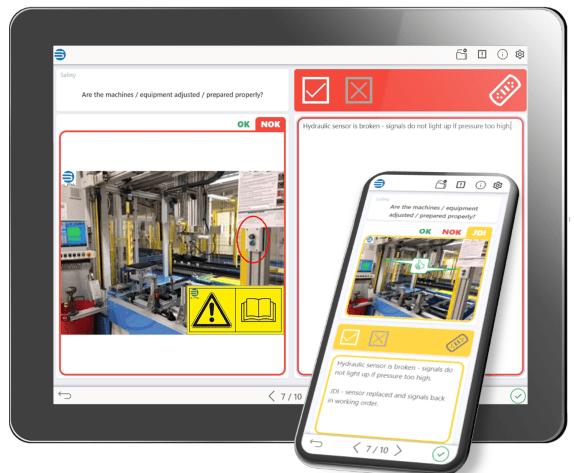
Mobile LPA Apps Replace Excel and Manual Audit Processes
The introduction of a centrally deployed LPA app fundamentally changed the way audits were executed across global manufacturing sites. Instead of documenting audits after completion, auditors could perform and record audits directly on smartphones and tablets at the point of execution.
This immediately created several advantages:
- Digital audit checklists instead of paper forms
- Standardized audit requirements across all manufacturing sites
- Real-time visibility of audit findings
- Immediate assignment of corrective actions
- Faster escalation of critical quality issues
- Transparent audit history and documentation
- Simplified reporting and analytics
- Reduced administrative effort
However, the key benefit was not simply replacing paper with digital tools. Practical usability on the shop floor played an equally important role. Audits became faster, easier to perform, and more consistent across multiple plants and production locations.
Faster Response to Quality Issues with Mobile Audit Software
One of the major advantages of modern LPA apps is speed. While paper-based audits often required additional time for documentation, consolidation, and evaluation, audit findings became available immediately after completion. This enabled:
- Faster root cause analysis
- Earlier escalation of critical quality issues
- Direct tracking of corrective actions
- Increased accountability on the shop floor
- Better visibility for quality and management teams
Especially in complex manufacturing environments, this significantly reduces the risk of smaller process issues remaining unnoticed over extended periods of time.
Global Standards & Comparable Results
Many global manufacturers face challenges when audit processes differ from one location to another. Different audit methods, local requirements, and inconsistent evaluation approaches often make it difficult to compare results and share best practices across sites.
The implementation of a centralized LPA app enabled:
- Standardized audit requirements across all manufacturing sites
- Global audit checklists and workflows
- Consistent evaluation logic
- Comparable audit results and KPIs
- Cross-site transparency and visibility
- Faster sharing of knowledge and best practices
As a result, quality management was no longer limited to individual plants. Audit processes could now be managed, analyzed, and improved on a global scale.
Mobile LPA Apps Improve User Acceptance
A common reason why digital initiatives fail in manufacturing environments is low user adoption. If audit processes are time-consuming, require additional administrative work, or interrupt daily operations, employees often perceive them as an extra burden rather than a useful tool.
Modern LPA apps address this challenge through intuitive interfaces and mobile usage directly on the shop floor. Audits can be performed and documented immediately on smartphones or tablets without additional paperwork or post-processing activities.
As a result, audits become part of normal production operations rather than an additional administrative task, improving usability, consistency, and overall user acceptance across manufacturing sites.
Digital Audits for Modern Manufacturing Control
The real added value of an LPA app goes far beyond replacing paper-based audit processes. For the first time, audit information can be used in real time to support operational and quality-related decisions across manufacturing sites.
Instead of serving only as a compliance or documentation activity, audit data becomes an active part of production management and continuous improvement processes.
As a result, audits evolve from a static verification process into a dynamic tool for quality control, process optimization, and operational decision-making.
Conclusion
The introduction of LPA apps has fundamentally changed the role of audits in modern manufacturing environments. Instead of serving primarily as documentation activities, audits have become an active component of quality management and operational improvement.
Today, mobile LPA apps enable:
- Faster response to quality issues
- Global transperancy
- Reduced administration
- Standardized processes
- Improved audit quality
- Better traceability of findings and corrective actions
- Stronger integration into daily shop floor operations
Global manufacturers especially benefit from viewing audit processes not as isolated activities, but as part of an integrated digital quality strategy that supports standardization, transparency, and continuous improvement across all sites.